
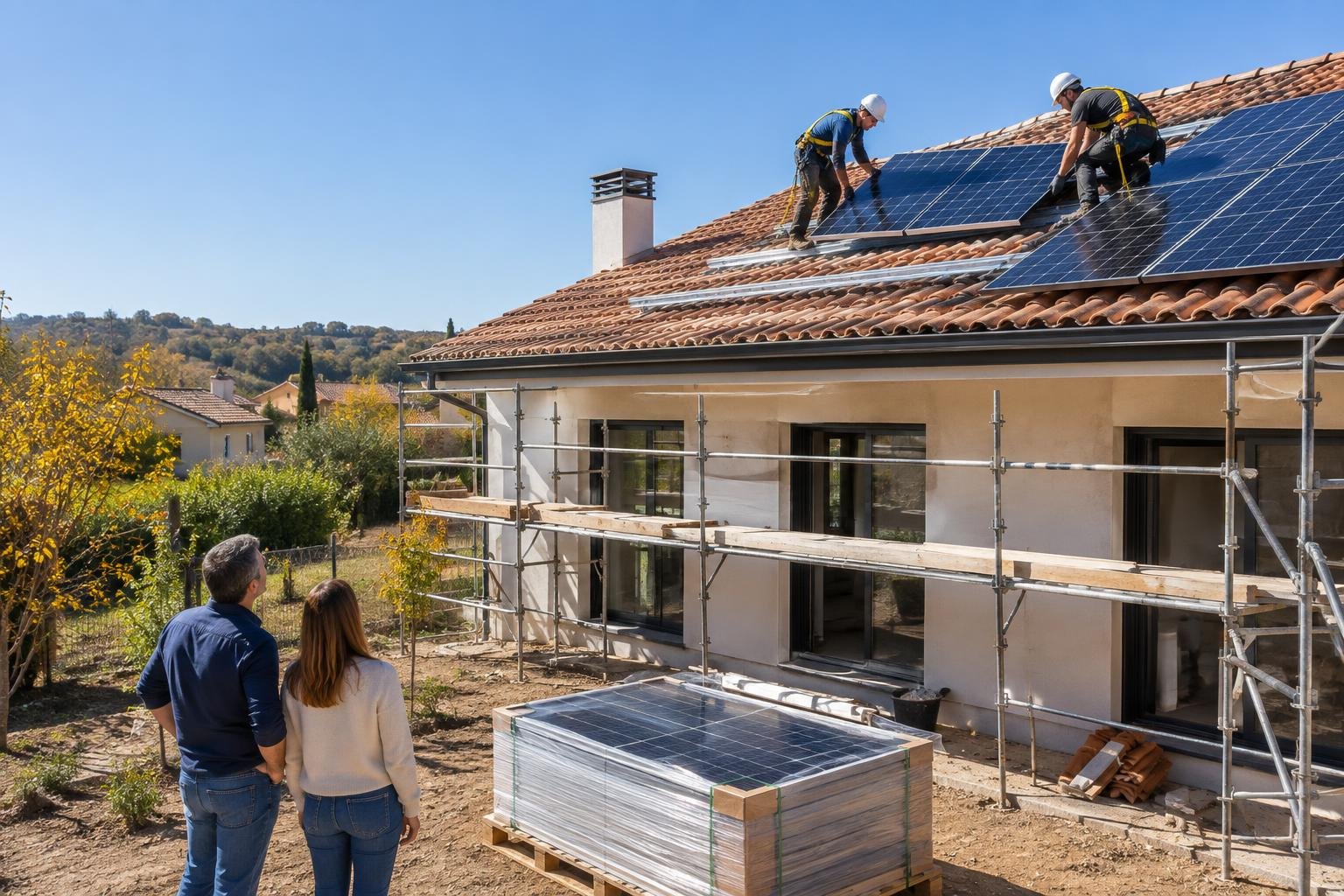
Why decide while the house is being designed
In a new house, the photovoltaic installation is not an add-on to sort out at the end: it affects the orientation and structure of the roof, the cable routes, where the inverter and the electrical panel go and, if applicable, the space for batteries. The Technical Building Code already requires new homes to limit their non-renewable energy use, and many owners consider solar panels to reduce it. The rule that governs how they connect and how the kilowatts you do not use are treated is Royal Decree 244/2019 on self-consumption, whose consolidated text in the BOE includes several later amendments. Choosing the mode at design stage avoids redoing installations and lets you compare quotes on the same basis.
Without surplus or with surplus: the first choice
The decree distinguishes two main modes. In self-consumption without surplus, the installation may never feed energy into the grid, and to guarantee this an anti-export mechanism must be fitted, which the decree itself defines as the device or set of devices that prevents it. In self-consumption with surplus, the installation may feed into the grid the energy the house is not using at that moment. According to the FAQ of the Ministry for the Ecological Transition, electricity sector rules set no general power limit for self-consumption beyond quality and industrial safety requirements; limits appear in some procedures and in compensation. The choice affects the equipment installed and the procedure with the distribution company.
Simplified compensation and when you can sell
Within self-consumption with surplus there is the mode under compensation. According to the Ministry, it requires renewable generation, production installations of no more than 100 kW and no additional or specific remuneration scheme; the decree adds that there must be a single supply contract for consumption and auxiliary services. Under it, the energy you export is deducted from the bill for the same billing period, which cannot exceed one month, and that deduction cannot be greater than the value of the energy you have taken from the grid. While under compensation you cannot sell the surplus: to sell it you must choose the mode not under compensation, with its own requirements. For a detached house, it is wise for the designer to estimate consumption and production before deciding.
Grid procedures that depend on power and land
The Ministry explains that installations without surplus are exempt from obtaining access and connection permits, and that installations with surplus are also exempt if their power is 15 kW or less and they are located on urbanised land with the facilities and services required by planning law. A house on a plot without those conditions may need a different procedure, so it is worth checking against the planning status of your land. In all cases the consumer must have an access contract, and if production is on the home's internal network and the holder is the same, a single contract may be enough. Generally one meter at the boundary point with the grid is sufficient. The regional governments collect the information on these installations and pass it to the national self-consumption register. Planning permits and electrical certification depend on your town council and your region: ask what they require before you start.
What to prepare before asking for a quote
So that builders and installers can price the house with the panels included, gather: the cadastral reference and the planning status of the plot; the drawings or preliminary design showing the orientation and pitch of the roof; an estimate of expected consumption (heating and cooling, hot water, kitchen, car charger if there will be one); whether you prefer self-consumption without surplus or with surplus and compensation; whether you want to leave space for batteries or a future extension; and the power you were planning to contract. Ask for each offer to itemise separately the photovoltaic installation, the inverter, the anti-export mechanism if applicable and the paperwork included. That way you can compare quotes on equal terms.
Your plot deserves a well-prepared proposal.
If you own the plot, present it confidentially to explore contacts with builders and developers. You can also look for a company to build on your land.
Submit my plotSources consulted
A Constructores.com guide. Informational content; every project requires professional assessment.